
Invethos has been investing in accordance with ethical criteria for over 15 years. A lot has happened during this time. Today, it is imperative to be able to demonstrate stringently how sustainability is implemented. In the current confusion of labels and approaches, it is important to focus on the essentials. This is how we do it:
1. Integrating sustainability and financial analysis
Sustainable entrepreneurship manifests itself in entrepreneurial success as well as in the assumption of social responsibility. Only those who have their figures under control and do not sell hot air are solid employers and viable in the long term. Conversely, appropriate ethical behaviour is an important signal for customers, employees, suppliers and the state. We therefore take both dimensions into account. The aim is to construct portfolios that comply with the rules of the art, deliver an appropriate performance and have a positive ethical footprint.
2. Not lumping everything together
Our methodology for listed investments is different from that for direct investments, so-called private markets. For listed investments, we focus on the following seven topics:
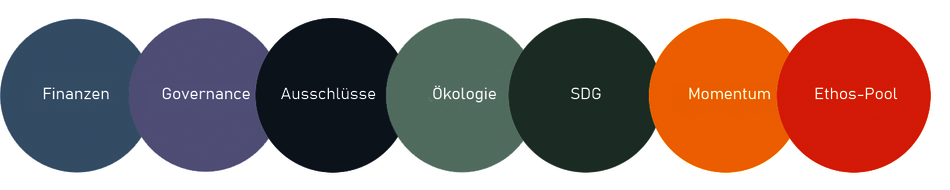
Healthy finances are the foundation of a good company. Governance refers to the management quality of a company. Exclusions are business areas or practices in which we do not wish to invest. There is increasingly precise data for measuring the topic of ecology (especially climate), which we take into account. SDG stands for Sustainable Development Goals, the UN's sustainability goals, which can be measured in terms of whether they are promoted or thwarted by companies. Momentum means that we not only invest in the role models, but also focus on change, which is more effective. This change, in turn, must be demanded, which is why we are involved in the Ethos Pool, which pools the market power of many large investors in order to persuade companies to make such changes.
This analysis is based on a wealth of data that we obtain from the provider MSCI and the Ethos Foundation. This means that we do not make decisions based on our own assumptions and emotions, but as fact-based as possible.
In the case of direct investments, we analyse the social and environmental impact depending on the topic. Impact Immobilien AG, for example, has developed its own scoring system that documents the social utilisation of properties. In the area of microfinance / development finance, the focus is on socially responsible lending and the utilisation of funds.
3. Openness to corrections and further developments
After years of boom, the topic of sustainability is increasingly facing headwinds. Dogmatic approaches that tend towards escapism and know-it-all attitudes are just as unlikely to move the world forward as concepts that are content with being slightly better than average. good solutions can often only be achieved through intensive discussions and without well-founded compromises, no progress can be made. We are therefore delighted to have an experienced team in our ranks that knows the limits of what is feasible and remains open to new ideas. Further information on sustainability and impact investments can be found on our website.