There are basically two ways for investors to invest in commodities. Firstly, there is the option of buying shares or bonds in companies that are active in this sector. For example, if the price of copper rises, then the profits of a copper mine are likely to rise and with them the price of the mining share. The second option, and the one we will discuss below, is to trade futures contracts on a commodity exchange such as the CBOT (Chicago Board of Trade). The best way to explain how this works is with an example:
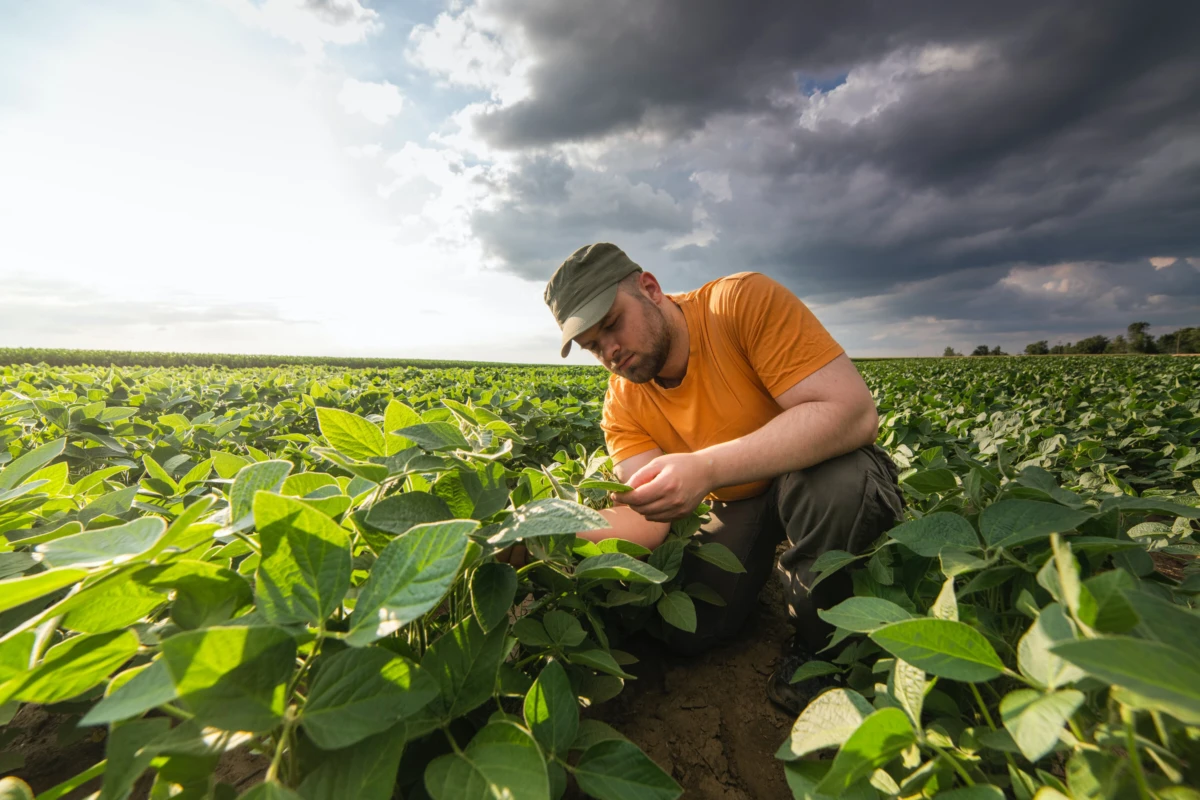
Ben is the manager of a large farming operation in the American Midwest. He assumes that he will produce one million "bushels" (approx. 35 litres each) of soya beans over the next twelve months. According to his calculations, he needs at least USD 10 per bushel to cover his costs. Futures contracts for soya beans to be delivered in twelve months are traded on the Chicago Commodity Exchange at a price of USD 15 per bushel. Ben decides to sell forward half of the expected harvest at USD 15: So he goes "short" 100 futures contracts of 5000 bushels each. He thus undertakes to deliver half a million bushels of soya beans at USD 15, regardless of the current price at that time. Example taken from [1].
Of course, a trade always requires two parties. In our example, the buyer of the futures is the trading department of a bank. According to the forecasts of the bank's commodity team, the price of soya beans will rise to USD 17. It is therefore interesting to buy a futures contract for this commodity today at USD 15. The bank is therefore "long" the contracts. Do Ben and the bank really want to swap soya beans with each other? It is conceivable, but in the vast majority of cases it does not take place. It is easier for Ben to deliver his beans to his usual customers at the daily price and to be settled financially for profit and loss. For the bank, it is even more the case: it has no way of storing half a million bushels of soya beans. The two counterparties therefore "even out" their positions before the futures contract expires and financially equalise profit and loss. If the bank's forecast is correct, it gains USD 2 per bushel. Ben could therefore have sold his beans at a higher price. However, if the price of soya beans is only USD 13, then Ben has done everything right and collects the difference of USD 2. In this case, there is no physical delivery.
This example illustrates what trading in commodity futures is all about: future price differences. These are derivatives that reflect the price, not the commodity itself. across all different commodities, no more than 5% of those futures contracts that have a delivery mechanism at all result in a physical purchase or sale of a commodity [2]. The motives with which the players enter the market vary greatly. Some want to hedge against future price fluctuations, others want to capitalise on these fluctuations. Such futures contracts exist for live cattle, steel, oil, gas, coffee and even soya beans.
How do we judge this market from an ethical perspective?
The ethically relevant issues can be roughly divided into two groups: Firstly, there is the issue of the production of raw materials: ecological overexploitation during the extraction of the raw material, CO2 emissions, etc.; the extraction of raw materials is often problematic from an ecological point of view. However, social issues such as the possible use of child labour and exploitative working conditions in general also need to be mentioned. The second group of problems centres around the effect of the financial market on the price development of raw materials. Are important goods suddenly becoming unaffordable due to speculative bubbles? Won't prices become more volatile due to the involvement of "speculators"? I would like to explore these questions below.
Commodity futures and the problems that arise in the production of commodities
The shareholders of a commodity-producing company strive to make a profit from this activity. The shareholders, as owners of this company, also bear responsibility for the damage to the natural environment that this causes. An effective way for investors to make the process of extracting raw materials more socially and ecologically sustainable is called "active engagement": Shareholders demand improvements from their management.
What about the influence of an investor who wants to profit from rising commodity prices by holding futures contracts? Futures are derivatives. Because of the existence of futures, no ore is mined, no coal is extracted or consumed. Futures may have an influence on the price, but they have no influence on the way in which a resource is extracted and consumed. The ecological "impact" of commodity futures is zero in both a negative and positive sense. Futures neither destroy nature nor do futures holders bring about a positive process. At best, it is conceivable that investor groups could exert influence on the commodity exchanges that specify the contracts. For example, they could demand that only socially and ecologically certified goods are accepted for physical delivery. Quality control also exists today, but (to my knowledge) it does not relate to social and ecological criteria. However, as only a small minority of futures lead to a genuine purchase of commodities, the real impact of this measure would probably not be great. Unlike the shareholders of commodity companies, who earn money from the production of commodities and also bear responsibility for the associated damage to ecosystems, investing in futures is not about the actual production of commodities, but about changing prices. A future therefore has no damaging effect on ecosystems.
Commodity futures and the problems of speculation with commodities
The opening up of a market once dominated by producers and buyers of commodities to financial investors has, of course, not been without consequences for price trends. The question is how prices were influenced and whether this influence was and is harmful. Particularly during and after the 2008 financial crisis, accusations were made that financial investors who diversified their risks away from traditional equity and bond portfolios into the commodity markets caused a food price bubble. Hunger among the most vulnerable, it was argued, was the result. However, this thesis has been scientifically scrutinised in the years following the financial crisis. The studies I am aware of indicate that the influence of financial investors was overestimated [3], [4]. Economic history studies over much longer periods of time even argue in a completely different direction: "speculators" do not increase price fluctuations, they actually incentivise them. Bans on futures markets led to the opposite of what the authorities wanted to achieve: Prices became more volatile [5]. Historical experience seems to exonerate the futures market from the accusation of driving prices speculatively. However, a shadow of doubt remains in a market that is modest in size compared to equity and bond markets. The possibility that financial investors could influence the prices of commodities by dominating the market is, in my opinion, a given.
Conclusion
As a responsible asset manager, Invethos always takes ethical considerations into account when making investment decisions. Would we shy away from investing in the commodity markets for ethical reasons?
Commodity futures are different from shares and bonds of commodity producers. Futures influence neither the quantity nor the method of production of commodities. It is hardly possible, for example, to assign a CO2 footprint to a futures contract on a type of oil. Price and production or consumption are not the same thing. The futures contract therefore causes no ecological damage. However, it does not bring about the kind of positive change that a shareholder in a mining company can strive for. From an ecological point of view, therefore, there is nothing in favour of or against the use of commodity futures in the portfolio context. As far as the effect of financial investors on the price structure is concerned, there is much to suggest that the involvement of financial investors in the futures market for commodities smoothes price movements. On the whole, the financial markets can be absolved of the accusation of driving prices speculatively. However, there are caveats to this judgement: we do not know how investment flows will change in the future. Even if experience speaks against it, the possibility of a price bubble induced by speculators seems at least conceivable.
I therefore see no strong ethical reasons to refrain from investing in commodities via the futures market. However, I would make one important qualification to this statement: I would refrain from investing in investment products that contain food, the so-called "soft commodities". History does provide us with evidence that no damage has been done to date by investing in these markets. But history also teaches us that financial investors can generally cause bubbles. We at Lebensmittel do not want to assume any potential co-responsibility for this. It is therefore important to choose a fund that ignores soft commodities.
In an inflationary environment such as the one we are currently experiencing, investing in commodity futures is one way of protecting yourself against the loss of purchasing power. This is also an important and legitimate motive. As a responsible asset management company, we are keen to discuss the ethical aspects of investment decisions and share our thoughts with you.
Do you see things differently? Let me know!
Jonas Steinmann, Invethos
Image: UNSPLASH in collaboration with Getty Images Photo of farmer in soya fields. Growth, outdoor)